


LATEST NEWS






LATEST PUBLICATIONS
Goldenfein, J., Yang, F., Sinclair, A., & Weatherall, K. (2026). AI Procurement in the Victorian Public Sector. ARC Centre of Excellence for Automated DecisionMaking and Society.
Weatherall, K., Zeng,J., Meese, J., Thomson, T.J., Goldenfein, J., Stirling, M., Watt, N., Angus, D., Parker, C., Bello y Villarino, J-M, Sheard, N., Przhedetsky, L., Burgess, J., & Fraser, H. (2026). ADM+S Submission to the Joint Select Committee on Artificial Intelligence. ARC Centre of Excellence for Automated DecisionMaking and Society.
Parker, C., Angus, D., Burgess, J., Carah, N., Fraser, H., Meese, J., Nelson, L., Stirling, M., Thomas, J., & Weatherall, K. (2026). ADM+S Submission to the Department of Infrastructure, Transport, Regional development, Communications, Sport and the Arts: Exposure Draft Digital Duty of Care Bill (2026). ARC Centre of Excellence for Automated Decision-Making and Society.
WHAT WE DO
The rapid expansion of automated decision-making enabled by technologies from machine learning to the blockchain has great potential benefits, while it also creates serious new risks to human rights and welfare.

Potential harms range from data discrimination against disadvantaged communities to the spread of disinformation for political and commercial ends. Increasing inequality, lower productivity and diminished economic security have been highlighted as risks in the coming decade.
The ARC Centre of Excellence for Automated Decision-Making and Society (ADM+S) is a cross-disciplinary, national research centre, which aims to create the knowledge and strategies necessary for responsible, ethical, and inclusive automated decision-making. Funded by the Australian Research Council from 2020 to 2026, ADM+S is hosted at RMIT in Melbourne, Australia, with nodes located at eight other Australian universities, and partners around the world.
The Centre brings together leading researchers in the humanities, social and technological sciences in an international industry, research and civil society network. Its priority domains for public engagement are news and media, mobilities, social services and health.
The Centre’s objectives are to:
- Generate an integrated understanding of ADM
- Formulate world-leading policy and practice in responsible, ethical and inclusive ADM, for governments, industry and the non-profit sectors;
- Enhance public understanding and inform public debate on ADM; and
- Educate and train researchers and practitioners in this challenging new field.
OUR VISION


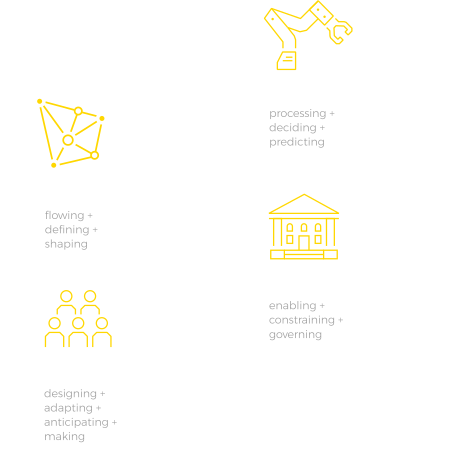
Automation is no longer just about robots making things: increasingly, it involves computers making decisions. We rely on computers to process data, make predictions, apply rules, choose actions and determine outcomes. Automated decision-making comprises an expanding array of intelligent technologies – from deep learning to blockchains – which promise to solve challenging problems across many sectors, from healthcare and social services to transport and media.

Centre Director Julian Thomas
Data science +
Critical data studies +
Computer science +
Law +
Regulatory theory +
Economics +
Ethics +
Sociology +
Design +
Anthropology +
Ethical design for ADM machines +
Sustainable governance +
Public engagement,
co-design and trust